Showing posts with label Computers. Show all posts
Showing posts with label Computers. Show all posts
Jul 12, 2011
By Sam Oliver: Apple Insider
Apple continues to express interest in developing affordable technologies that could in the near future deliver an easy-to-use augmented reality platform to its iOS devices like the iPad through the use of split-screen software techniques or transparent display screens, company filings reveal.
Augmented reality (AR) is a term used to describe a live direct or an indirect view of a physical, real-world environment whose elements are augmented by computer-generated sensory input, such as annotations, sound or graphics presented through an information layer.
In one filing published for the first time Thursday by the United States Patent and Trademark Office and discovered byAppleInsider, Apple notes that despite strong academic and commercial interest in (AR) systems, many existing implementations are complex and expensive, making them unsuitable for general use by the average consumer.
As part of its filing, Apple proposes that iPads could feature a split screen display that can be used to display an object or subject matter such as a live video feed from the tablet's camera on one side of the split, and computer-generated imagery identifying elements in that video feed on the second side of the split.
In one example shown, a user is viewing a live video of the skyline of downtown San Francisco in first display area, while object recognition is performed in real-time on a captured frame of the video to present information on the second display area, such as balloon call outs identifying the buildings or structures in the live video.
Software running on the iPad could utilize onboard positioning system such as GPS, WiFi, and Cell ID ,along with motion sensors to transmit information about the live feed to a network service, which could then spit back 3D models of recognized objects in the live feed that the user could navigate in real-time.

"For example, gyroscopes, magnetometers and other motion sensors can provide angular displacements, angular rates and magnetic readings with respect to a reference coordinate frame, and that data can be used by a real-time onboard rendering engine to generate 3D imagery of downtown San Francisco," Apple said. "If the user physically moves device, resulting in a change of the video camera view, the information layer and computer-generated imagery can be updated accordingly using the sensor data."
More specifically, the company provided an example where the user sets a marker via a pushpin on a building seen in the distance so that a driving or walking route can be computed in real-time and overlaid on the 3D computer-generated imagery to provide directions to that building from the user's current location.

Optionally, Apple added that the annotated live video, computer-generated imagery and resulting information layer can be shared via a Share Button with one or more other devices, and the AR displays of the devices can be synchronized to account for changes in video views.
While the filing proposes an AR implementation utilizing existing technologies found on the iPad (and iPhone), a second filing from the company relating to the same subject matter is slightly more ambitious in that it proposes iPads with a display screen having a viewing area with a transparent portion that enables a user to view objects behind the electronic device by looking through the display screen.
The "transparent portion may encompass the entire viewing area, or only a portion of the viewing area of the display," wrote Apple engineer Aleksandar Pance, who is the sole inventor credited to the patent application titled "Transparent Electronic Device." He added that additional implementations could call for an iPad with two or more display screens (each having respective viewing areas with transparent portions) arranged in an overlaid or back-to-back manner, or two display screens whereby one display screen is partially opaque but displays a transparent window that's movable via multitouch input from the user.
"These overlays whether in handheld or other electronic devices, may provide an 'augmented reality' interface in which the overlays virtually interact with real-world objects," Pance wrote. "For example, the overlays may be transmitted onto a display screen that overlays a museum exhibit, such as a painting. The overlay may include information relating to the painting that may be useful or interesting to viewers of the exhibit. Additionally, overlays may be utilized on displays in front of, for example, landmarks, historic sites, or other scenic locations. […] For example, a tour bus may include one or more displays as windows for users. These displays may present overlays that impart information about locations viewable from the bus.

The same filing also details a viewing routine that would allow a user to view both images and real world events simultaneously via a single display screen. For example, the viewing routine may allow for a portion of the display to be selectively transparent while the remainder of the area of the display screen is opaque.
"For example, display screen may include an in-plane switching LCD screen in which pixels of the screen default to an 'off' state that inhibits light transmission through the screen," Pance explained. "This may be accomplished by driving a voltage to zero to the pixels in an 'off' state (i.e., the pixels in an opaque region)" while "voltage could then be applied to pixels of the display screen to enable light transmission through such pixels (when desired), allowing a user to view real-world objects through the activated pixels of display screen, thus generating a window in the opaque region."
Apple said such futuristic displays screens may include an LCD having pixels that default to an "on" state allowing light transmission and which can be activated to render some or all of the pixels opaque. Alternatively, the company said that the screens could include an OLED.
Apple continues to express interest in developing affordable technologies that could in the near future deliver an easy-to-use augmented reality platform to its iOS devices like the iPad through the use of split-screen software techniques or transparent display screens, company filings reveal.
Augmented reality (AR) is a term used to describe a live direct or an indirect view of a physical, real-world environment whose elements are augmented by computer-generated sensory input, such as annotations, sound or graphics presented through an information layer.
In one filing published for the first time Thursday by the United States Patent and Trademark Office and discovered byAppleInsider, Apple notes that despite strong academic and commercial interest in (AR) systems, many existing implementations are complex and expensive, making them unsuitable for general use by the average consumer.
As part of its filing, Apple proposes that iPads could feature a split screen display that can be used to display an object or subject matter such as a live video feed from the tablet's camera on one side of the split, and computer-generated imagery identifying elements in that video feed on the second side of the split.
In one example shown, a user is viewing a live video of the skyline of downtown San Francisco in first display area, while object recognition is performed in real-time on a captured frame of the video to present information on the second display area, such as balloon call outs identifying the buildings or structures in the live video.
Software running on the iPad could utilize onboard positioning system such as GPS, WiFi, and Cell ID ,along with motion sensors to transmit information about the live feed to a network service, which could then spit back 3D models of recognized objects in the live feed that the user could navigate in real-time.
"For example, gyroscopes, magnetometers and other motion sensors can provide angular displacements, angular rates and magnetic readings with respect to a reference coordinate frame, and that data can be used by a real-time onboard rendering engine to generate 3D imagery of downtown San Francisco," Apple said. "If the user physically moves device, resulting in a change of the video camera view, the information layer and computer-generated imagery can be updated accordingly using the sensor data."
More specifically, the company provided an example where the user sets a marker via a pushpin on a building seen in the distance so that a driving or walking route can be computed in real-time and overlaid on the 3D computer-generated imagery to provide directions to that building from the user's current location.
Optionally, Apple added that the annotated live video, computer-generated imagery and resulting information layer can be shared via a Share Button with one or more other devices, and the AR displays of the devices can be synchronized to account for changes in video views.
While the filing proposes an AR implementation utilizing existing technologies found on the iPad (and iPhone), a second filing from the company relating to the same subject matter is slightly more ambitious in that it proposes iPads with a display screen having a viewing area with a transparent portion that enables a user to view objects behind the electronic device by looking through the display screen.
The "transparent portion may encompass the entire viewing area, or only a portion of the viewing area of the display," wrote Apple engineer Aleksandar Pance, who is the sole inventor credited to the patent application titled "Transparent Electronic Device." He added that additional implementations could call for an iPad with two or more display screens (each having respective viewing areas with transparent portions) arranged in an overlaid or back-to-back manner, or two display screens whereby one display screen is partially opaque but displays a transparent window that's movable via multitouch input from the user.
"These overlays whether in handheld or other electronic devices, may provide an 'augmented reality' interface in which the overlays virtually interact with real-world objects," Pance wrote. "For example, the overlays may be transmitted onto a display screen that overlays a museum exhibit, such as a painting. The overlay may include information relating to the painting that may be useful or interesting to viewers of the exhibit. Additionally, overlays may be utilized on displays in front of, for example, landmarks, historic sites, or other scenic locations. […] For example, a tour bus may include one or more displays as windows for users. These displays may present overlays that impart information about locations viewable from the bus.
The same filing also details a viewing routine that would allow a user to view both images and real world events simultaneously via a single display screen. For example, the viewing routine may allow for a portion of the display to be selectively transparent while the remainder of the area of the display screen is opaque.
"For example, display screen may include an in-plane switching LCD screen in which pixels of the screen default to an 'off' state that inhibits light transmission through the screen," Pance explained. "This may be accomplished by driving a voltage to zero to the pixels in an 'off' state (i.e., the pixels in an opaque region)" while "voltage could then be applied to pixels of the display screen to enable light transmission through such pixels (when desired), allowing a user to view real-world objects through the activated pixels of display screen, thus generating a window in the opaque region."
Apple said such futuristic displays screens may include an LCD having pixels that default to an "on" state allowing light transmission and which can be activated to render some or all of the pixels opaque. Alternatively, the company said that the screens could include an OLED.
May 13, 2011

It seems Fujitsu's got a thing for morphing PCs. Now the outfit's short-listed this deja-vu-inducing transformer for its 2011 "Life with Future Computing Award." The Flexbook, designed by Hao-Chun Huang, features a foldable 21:9 touchscreen and similarly flexible keyboard that allow its users to switch from laptop to tablet to book-like e-reader. It's also been designed to sport a number of interchangeable sleeves in a array of colors and patterns. It might have seemed impractical five years ago, but with convertibles coming of age, I'd say the Flexbook isn't really all that far out.


SHARE THIS
Apr 20, 2011
Yesterday marked the release of the new Blackberry Playbook, which is a tablet that is said to compete with the iPad 2 and the Xoom. The Playbook is smaller than the two popular tablets but packs a big punch and will be a thorn is the side of Apple and Motorola. The Playbook doesn't have any buttons on the front of the device, instead all is controlled with touch gestures. It took a while for me to get use to the gestures and kept on forgetting what does what. This device will be difficult for people to get use to especially when you don't have a home button that is easy to push to get to the home menu. Other than that the device is overall fun to play with and the user interface is well set up. Lets take a look at the specs of the Blackberry Playbook.
 Ultra portable, super convenient
Height 5.1" / 130mm
Width 7.6" / 194mm
Depth 0.4" / 10mm
Weight 0.9 lbs / 425g
7" LCD display, 1024 x 600 screen resolution
Multi-touch, WSVGA, capacitive screen
Professional grade performance
Get started easily – simply swipe-to-wake
Full computing power in a tablet format
1 GHz dual-core processor, 1 GB RAM
Symmetric multi-processing
Accelerometer, 6-axis motion sensing (gyroscope), digital compass (magnetometer) and GPS
Micro USB port
Uncompromised web
Games, media, apps and everything the real Internet offers
Full Adobe® Flash® 10.1 enabled
Built-in support for HTML 5
No-compromise rendering of text, graphics and video
Connect anytime, anywhere
BlackBerry PlayBook tablets will offer support for network configurations as follows:
BlackBerry PlayBook with Wi-Fi 802.11 a/b/g/n
 BlackBerry 4G PlayBook with Wi-Fi 802.11 a/b/g/n + WiMax
BlackBerry 4G PlayBook with Wi-Fi 802.11 a/b/g/n + LTE
BlackBerry 4G PlayBook with Wi-Fi 802.11 a/b/g/n + HSPA+
All BlackBerry PlayBook tablets support Bluetooth® 2.1+EDR
Amplified BlackBerry experience
Wirelessly connect to your BlackBerry® smartphone* for real time access to:
Email, calendar, address book and task list, using
BlackBerry® Bridge™
Best-in-class media
3 MP high-definition forward-facing camera
5 MP high-definition rear-facing camera
Stereo speakers and stereo microphones
Crystal clear video; H.264, MPEG4, WMV HDMI video output
Micro USB and Micro HDMI ports
Business ready
BlackBerry Bridge technology
Corporate intranet browsing
DocsToGo, Adobe Reader
Enterprise VPN
BlackBerry Tablet OS
Powerful, user-friendly QNX technology: It’s what the World Wide Web runs on
Multi-processing for true multitasking
First and only microkernel based end-to-end real time
operating system
Rich application ecosystem
Rapid development environment
Reliable BlackBerry Tablet OS, powered by QNX technology
Supports POSIX OS, SMP, Open GL, BlackBerry® 6, WebKit, Adobe Flash, Java® and Adobe Mobile AIR

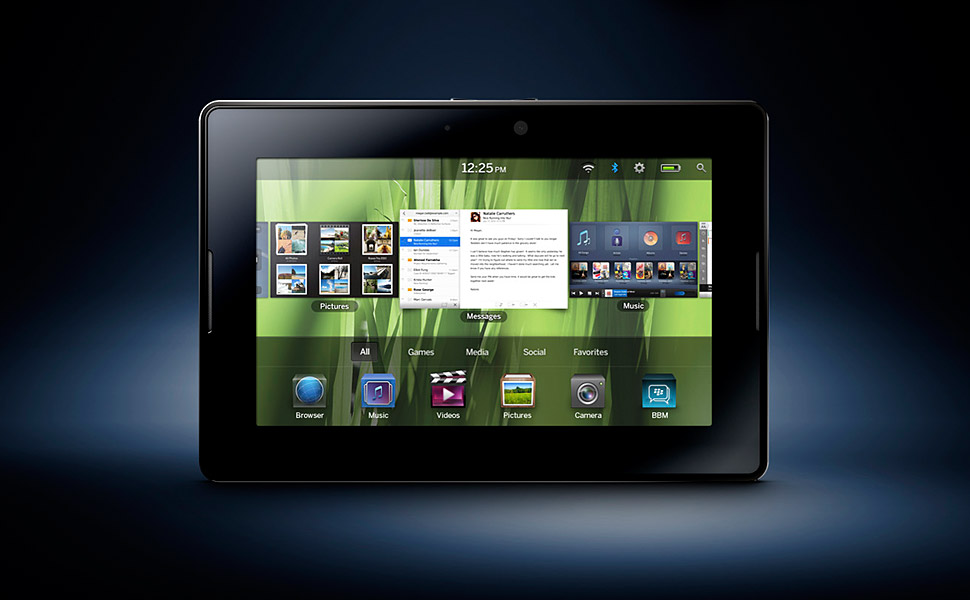 Ultra portable, super convenient
Height 5.1" / 130mm
Width 7.6" / 194mm
Depth 0.4" / 10mm
Weight 0.9 lbs / 425g
7" LCD display, 1024 x 600 screen resolution
Multi-touch, WSVGA, capacitive screen
Professional grade performance
Get started easily – simply swipe-to-wake
Full computing power in a tablet format
1 GHz dual-core processor, 1 GB RAM
Symmetric multi-processing
Accelerometer, 6-axis motion sensing (gyroscope), digital compass (magnetometer) and GPS
Micro USB port
Uncompromised web
Games, media, apps and everything the real Internet offers
Full Adobe® Flash® 10.1 enabled
Built-in support for HTML 5
No-compromise rendering of text, graphics and video
Connect anytime, anywhere
BlackBerry PlayBook tablets will offer support for network configurations as follows:
BlackBerry PlayBook with Wi-Fi 802.11 a/b/g/n

BlackBerry 4G PlayBook with Wi-Fi 802.11 a/b/g/n + LTE
BlackBerry 4G PlayBook with Wi-Fi 802.11 a/b/g/n + HSPA+
All BlackBerry PlayBook tablets support Bluetooth® 2.1+EDR
Amplified BlackBerry experience
Wirelessly connect to your BlackBerry® smartphone* for real time access to:
Email, calendar, address book and task list, using
BlackBerry® Bridge™
Best-in-class media
3 MP high-definition forward-facing camera
5 MP high-definition rear-facing camera
Stereo speakers and stereo microphones
Crystal clear video; H.264, MPEG4, WMV HDMI video output
Micro USB and Micro HDMI ports
Business ready
BlackBerry Bridge technology
Corporate intranet browsing
DocsToGo, Adobe Reader
Enterprise VPN
BlackBerry Tablet OS
Powerful, user-friendly QNX technology: It’s what the World Wide Web runs on
Multi-processing for true multitasking
First and only microkernel based end-to-end real time
operating system
Rich application ecosystem
Rapid development environment
Reliable BlackBerry Tablet OS, powered by QNX technology
Supports POSIX OS, SMP, Open GL, BlackBerry® 6, WebKit, Adobe Flash, Java® and Adobe Mobile AIR

Jan 26, 2011
the Logitech Wireless Mouse M515 features a sealed bottom case that lets you mouse around on soft surfaces without snagging. That means it won't collect bits of fuzz around the sensor when dragging it across the couch, bed, or a trouser-clad thigh. Naturally, it can also be used on more traditional computing surfaces, too. The M515 boasts up to two-years of battery life thanks, in part, to a hand-detection sensor that causes the mouse to sleep anytime it's not being held. Rounding out the list of features is Logitech's Hyper-Fast scrolling wheel and Unifying USB micro receiver required for the laptop or home theater PC you wish to control. Look for the M515 to ship to Europe in April for £49.99 -- that's about $80 converted, but you'll likely find it for a lot less whenever it hits US retail.


Subscribe to:
Posts (Atom)